We help businesses map complex B2B buying cycles inside Salesforce so marketing and sales share one source of truth. Half of leads entering a sales funnel aren’t ready to buy, and 86% of B2B purchases stall during the buying process. We use those facts to focus efforts where they matter most.
By analyzing conversion rates from website visitors, we pinpoint the exact stage where prospects drop off. Our process combines high-quality content, landing page tools, and accurate contact capture to nurture potential customers through each stage.
Trust matters. We deploy social proof and case studies to build credibility and use personalized email resources to move visitors toward long-term customers. Data hygiene in Salesforce keeps records consistent and improves tracking of every landing page interaction.
Key Takeaways
- Half of leads may not be ready; identify and nurture early-stage prospects.
- 86% of B2B purchases stall — map where deals stop and act fast.
- Use Salesforce as a single source of data for marketing and sales alignment.
- Combine content, landing pages, and email to boost conversion rates.
- Maintain strict data hygiene to track every interaction and improve results.
Understanding the Modern B2B Buying Cycle
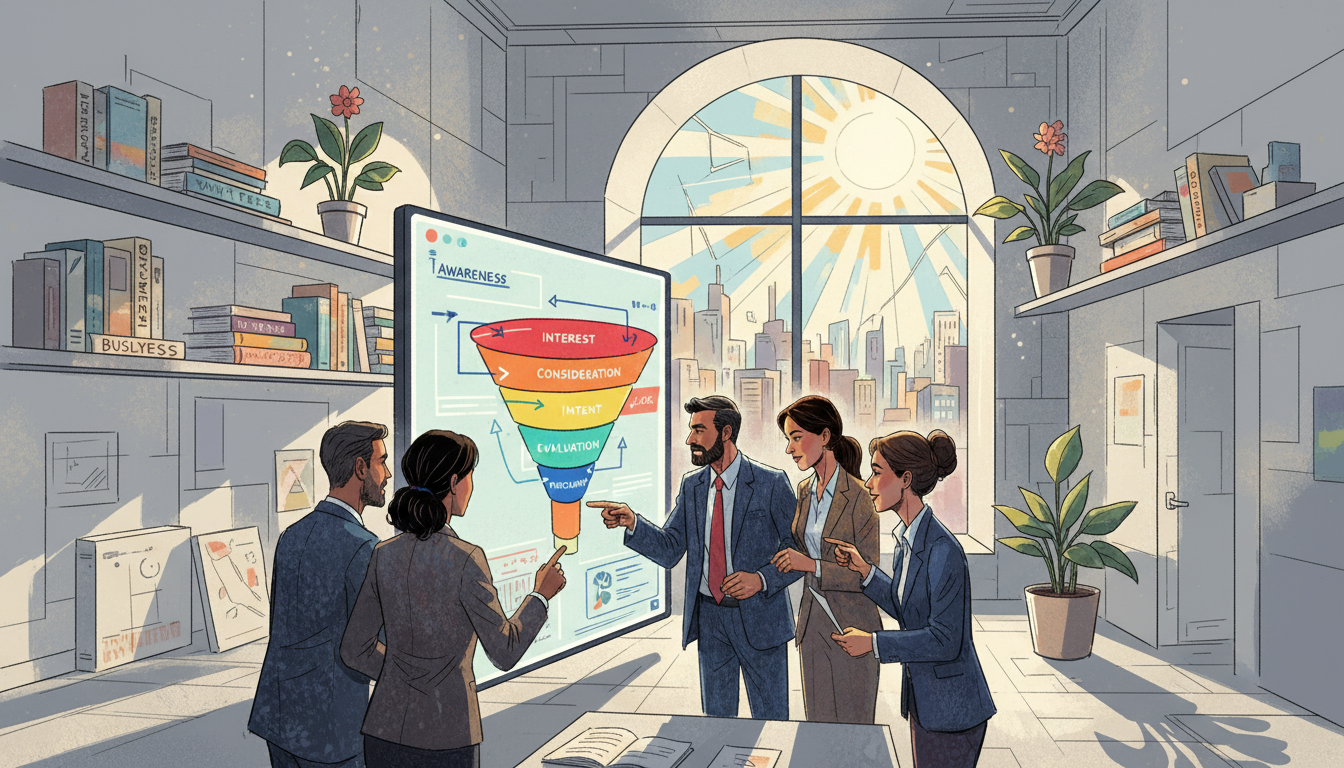
Understanding how buyers move from awareness to action helps us design clearer paths that reduce stalled deals. We map four primary funnel stages: awareness, interest and evaluation, desire, and the final action. This structure guides the content and tools we build to support buyers at each step.
Mapping the Customer Journey
We treat mapping as a practical checklist. First, we identify where prospects enter and which stage they leave.
Then we match targeted educational content to each stage so potential customers can self-educate. This matters because 61% of B2B buyers prefer to research without reps.
Addressing Common Deal Stalls
Deal stalls happen for predictable reasons. We add ROI calculators, implementation roadmaps, and clear comparison assets so buyers can validate choices alone.
- Focus on awareness: Make your product service visible to the right audience early.
- Consistent messaging: Keep marketing aligned across all funnel stages to avoid mixed signals.
- Data-driven fixes: Use analytics to pinpoint stalls and supply the content that moves customers toward conversion.
Defining Sales Funnel Optimization for Salesforce Users
We define a clear process that improves conversion rates and revenue at every stage of the pipeline.
For Salesforce users, this means standardizing lifecycle definitions so marketing and sales share one source of truth. Clean data is the backbone of that work.
Highly aligned companies grow faster and earn more. According to Salesgenie, aligned teams grow 19% faster and are 15% more profitable. That gain comes from a repeatable process that tracks how prospects move through stages.
RevOps teams in 2026 focus on data hygiene and lifecycle orchestration instead of adding more tools. We prioritize the same. This helps us spot bottlenecks and measure the conversion rate at each stage.
- Standardize lifecycle definitions in Salesforce.
- Track conversion rates by stage to forecast revenue.
- Refine business process to remove friction and improve outcomes.
| Metric | Purpose | Primary Action | Expected Result |
|---|---|---|---|
| Stage conversion rate | Identify drop-off points | Standardize lifecycle stages | Predictable revenue |
| Data completeness | Ensure measurement accuracy | Implement hygiene rules | Reliable forecasts |
| Touchpoint attribution | Link marketing to outcomes | Integrate funnels into Salesforce | Clear ROI view |
| Process cycle time | Reduce friction | Refine steps and handoffs | Faster close rate |
Segmenting Your Target Audience for Better Engagement
We turn raw contact records into actionable personas that guide targeted outreach. Starting with clean data, we map behavior and firmographics to see which groups respond best.
Developing Detailed Buyer Personas
We build personas from real signals in Salesforce and enrichment tools. That lets us fill missing fields like title, company size, and industry so messaging reaches the right prospects at the right time.
Relevance matters: 73% of buyers avoid outreach that feels irrelevant. We focus on tailored content and timing to improve engagement across the sales funnel.
- Segment by behavior and firmographics observed in your CRM.
- Create messaging aligned to each persona’s core pain points.
- Use enrichment to complete contact profiles and improve targeting.
- Track engagement to see which personas convert and iterate quickly.
- Prioritize the customer experience to build long-term trust.
| Persona | Key Traits | Primary Message |
|---|---|---|
| IT Decision Maker | Technical, risk-averse, 500+ employees | Implementation readiness and security benefits |
| Line Manager | Cost-conscious, short evaluation cycles | Efficiency gains and fast ROI |
| CEO / Founder | Strategic, growth-focused | Business impact and competitive advantage |
Creating Tailored Content for Every Funnel Stage
We design content pathways that match buyer intent across each stage of the sales funnel. This approach turns early curiosity into qualified interest and shortens the time it takes prospects to move forward.
Awareness Stage Educational Assets
At the awareness stage we publish clear, solution-focused articles and guides. Educational content raises trust: readers are 131% more likely to buy after consuming useful material.
Consideration Stage Comparison Tools
For consideration we deploy vendor comparison matrices and ROI calculators. These tools help customers evaluate your product service against alternatives and improve conversion by removing uncertainty.
Decision Stage Implementation Resources
At decision time we provide implementation roadmaps and procurement templates. These resources help buyers secure internal approval and speed final commitment.
| Asset | Purpose | How We Use It |
|---|---|---|
| Educational Article | Build awareness and trust | SEO-driven landing content that captures interest |
| ROI Calculator | Quantify value | Embedded on landing page to increase conversion |
| Vendor Matrix | Compare options | Gated tool for qualified leads |
| Implementation Roadmap | Remove adoption barriers | Shared during sales conversations to close customers |
Capturing High-Quality Leads with Strategic Magnets
We use high-value magnets—ebooks, webinars, and templates—to trade useful content for accurate contact information. This creates a clear exchange and reduces low-quality entries. Apollo supports this approach with 224 million verified contacts and 96% email accuracy, helping us find buyers fast.
We integrate these offers into social media and email campaigns so they reach the right audience. That amplifies reach and taps the growing social commerce market, which is projected to hit $79.64 billion in the US by 2025.
- We align each magnet to stage-based messaging to increase conversion and lead quality.
- We collect only essential fields to maximize conversions and preserve data accuracy.
- We route captured leads into Salesforce with enrichment flags for fast follow-up.
| Lead Magnet | Primary Goal | Promotion Channel |
|---|---|---|
| Ebook | Educate and capture qualified leads | Email, LinkedIn |
| Webinar | Engage prospects and collect contact information | Social media, paid ads |
| Template / Toolkit | Show immediate value and boost conversion | Organic posts, remarketing |
Optimizing Landing Pages to Reduce Friction
A well-designed landing page guides visitors to the exact next step without confusion. We start by matching content to the buyer’s stage so visitors see relevant messages. That alignment drives results: targeting content by position in the buying cycle yields about 72% higher conversion.
We use heatmaps and session recordings to watch real user paths. These tools show which page elements draw attention and which are ignored.
Utilizing Heatmaps for User Behavior Analysis
With heatmaps we spot hot zones and dead zones fast. Then we simplify navigation, reduce clicks, and remove barriers to contact information.
- Design for clarity: Reduce clutter so visitors find CTAs and benefits quickly.
- Minimize form fields: Ask only for essential contact information to boost completion rates.
- Test variations: A/B tests reveal headlines, images, and layouts that improve conversion.
- Use social proof: Testimonials and trust badges build credibility for hesitant customers.
- Mobile-first: Ensure the website experience is smooth across devices.
Leveraging Social Proof to Build Trust
We use authentic customer voices to shorten the path from interest to commitment. Social proof gives potential customers a fast way to judge credibility. Ninety-seven percent of consumers factor reviews into buying choices, so reviews and success stories matter.
We display client reviews, case studies, and awards across the landing page and marketing channels to boost trust. This placement helps prospects move from consideration to the desire stage.
User-generated content—social posts, customer videos, and testimonials—adds real-world context that scripted copy cannot match. Social Media Examiner shows how well-placed testimonials increase confidence for event attendees.
- Feature reviews and quotes near CTAs so visitors see them when making decisions.
- Highlight client logos and short case wins to show reach and legitimacy.
- Use social media to amplify authentic stories and increase audience engagement.
We gather and showcase feedback systematically, so your brand reputation stays strong. By building trust this way, we reduce hesitation and improve conversion through targeted funnel optimization.
Implementing A/B Testing for Continuous Improvement
A/B testing gives us clear answers about what content and design persuade your audience most. We run controlled experiments across landing page and email variants to compare outcomes. This approach turns guesses into measurable wins.
We test headlines, CTAs, images, and form length to find the combinations that lift conversion. We also try different social proof placements and social media hooks to see how reviews and posts change behavior.
Matomo is one of the tools we use to run experiments and collect reliable data. It tracks how visitors interact with each version and shows which changes move prospects to the next stage faster.
- Compare two versions and measure lift in conversion and time spent per stage.
- Analyze results to learn audience preferences and refine content continually.
- Create a culture of testing so improvements compound over time.
| Test Element | Goal | Metric |
|---|---|---|
| Headline | Improve clarity | Click-through rate |
| CTA & button | Increase leads | Conversion rate |
| Social proof | Build trust | Form completions |
Analyzing Performance Metrics to Drive Revenue
We measure the signals that matter — conversion rate, stage velocity, and average deal size — and turn them into revenue-focused actions.
Our process tests where visitors and leads slow down. The average B2B conversion rate is 2.9%, so small gains matter. We prioritize fixes that deliver the largest revenue delta for your business.
We standardize lifecycle definitions so marketing and sales share one source of information. That alignment helps teams grow faster and run more profitably — aligned companies grow 19% faster and are 15% more profitable.
We audit landing page and page performance to ensure the right audience converts at each stage. Then we track lead count and lead quality so results map to revenue goals.
- Measure conversion rate, velocity, and deal size.
- Map bottlenecks across stages and act quickly.
- Deliver regular reports that show how investments translate to results.
| Metric | Why it matters | Primary action |
|---|---|---|
| Conversion rate | Shows landing and page effectiveness | Optimize forms and messaging |
| Stage velocity | Reveals cycle time issues | Improve handoffs and process |
| Average deal size | Direct revenue impact | Prioritize high-value segments |
We use data to forecast and refine processes continuously. With clear metrics and focused optimization, your team can predict revenue and scale growth in the competitive B2B market.
Conclusion
This conclusion outlines a clear action plan to audit your customer journey and fix the biggest bottlenecks.
We showed a systematic way to map complex B2B buying cycles in Salesforce so teams can spot and unblock deal stalls fast. Clean data and honest performance measurement let us choose the highest-impact fixes.
Use tailored content and self-serve assets to let buyers progress independently. Then run quick audits to find the single biggest conversion choke point and address it first.
Start with stage-specific improvements and measure each change. With focused effort, we help your team convert more prospects into happy, loyal customers and sustain better long-term results.